How should parents give reasonable guidance to children who use new media to become younger?
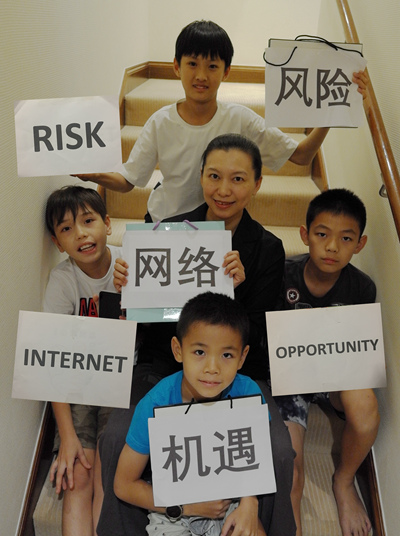
Chen Qingwen, an associate professor at Tongji University, pointed out that parents should balance the opportunities and risks of the Internet when guiding their children to surf the Internet. Photo courtesy of respondents
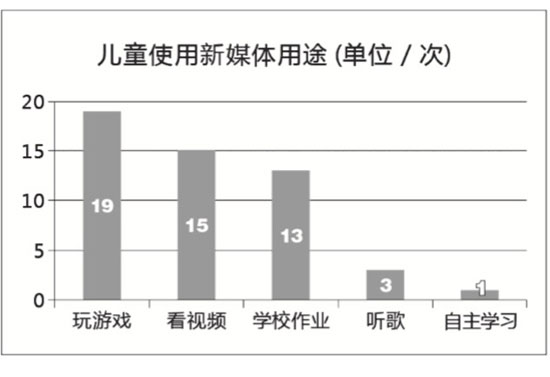
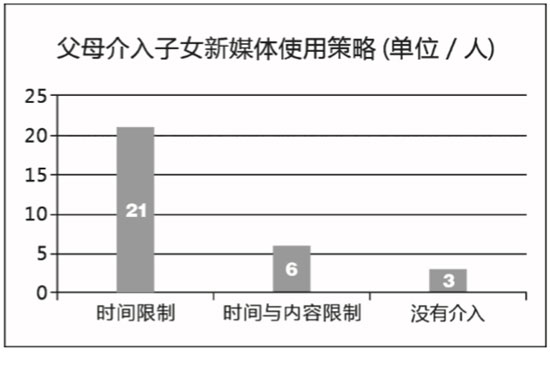
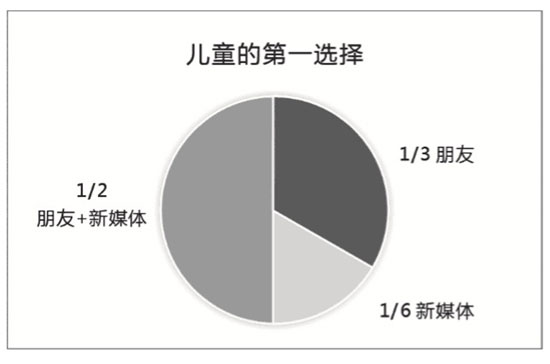
A chart based on interview data of Chen Qingwen’s team. Photo courtesy of respondents
I believe many people have had this experience: in some public places, "Xiong Haizi" played games or watched videos with electronic devices such as mobile phones and tablets, and the volume was so loud that parents turned a blind eye. Relevant research reports show that in China, children’s use of new media tends to be younger and more entertaining.
On the one hand, new media devices that can be networked, such as mobile phones and tablets, have grown up with a new generation of children and once became a "part" of their bodies; On the other hand, the powerful educational function and interpersonal communication use of new media also make it a sharp weapon for learning and communication.
As the mother of a post-00 generation child, Chen Qingwen, an associate professor at Tongji University’s College of Art and Media, faces the same problem: How and how often do children use new media? How should parents guide their children to use new media reasonably?
With these questions, Chen Qingwen and his team randomly interviewed 30 families of children aged 3-10 in Shanghai to learn about children’s use of new media, parents’ attitude and involvement in children’s use of new media, and children’s views on parental involvement. On this basis, suggestions are given, and the research results are published in the core journal "Journalist" in August 2019.
From "TV Children" to "New Media Children"
As a post-1970s generation, Chen Qingwen admitted that he "grew up watching TV". When he was a graduate student at Fudan University 15 years ago, he studied the newly-emerging children’s channel in China. She said that the transition from "TV children" to "new media children" was even faster than the growth of a generation. And this change has brought a kind of trouble to parents: it is difficult to guide children to use new media reasonably with reference to their own experience.
Some people may ask, how can they bring up the next generation when there was no TV in the older generation?
"Because the new media is more interactive, participatory and creative than the traditional media, but without learning and guidance, children may just regard the new media as TV or game consoles." Chen Qingwen explained that, at the same time, new media are everywhere, and the content is all-encompassing, which is very different from traditional TV and other media. You can leave TV at home, but you can’t live without the Internet and mobile phones. In modern cities, "portable" and "always online" have become the common points for people to use new media.
Chen Qingwen felt that "new media children" were born from the moment parents provided their children with new media equipment.
Among the 30 families interviewed, one-third of the children have their own new media equipment, and the other two-thirds share it with their parents, many of whom will leave their unused new media equipment for their children to use. In terms of use, most children play games, followed by watching videos, and the third is the homework assigned by the school.
According to statistics, more than half of the children use it for a long time, especially on weekends, almost for more than two hours a day. In the trend, many children in the kindergarten group have used new media for a long time, and the use time tends to lengthen with age. In addition, compared with the primary school group, the kindergarten group has a higher proportion of its own new media equipment, which shows that the use of new media is younger.
In March this year, the Research Report on the Internet Use of Minors in China in 2018 jointly issued by the Youth Rights Protection Department of the Central Committee of the Communist Youth League and China Internet Information Center showed that as of July 31, 2018, the number of underage netizens in China reached 169 million, and the Internet penetration rate of minors reached 93.7%, which was significantly higher than that of the national population (57.7%) in the same period. According to the report, this is a direct manifestation of the expansion of Internet coverage and the decline of mobile traffic charges in China in recent years, and it is also closely related to minors’ strong interest in the Internet, strong learning ability and great application demand.
Don’t let machines take the place of parents’ company
In the interview, the research team found that children’s use of new media is mostly due to lack of companionship, especially preschool children. Because parents are busy and have no friends to play with, children have to turn to mobile phones and tablets; With the increase of age, more and more children choose new media.
Some parents even choose to use new media instead of themselves to accompany their children. In public places such as restaurants, children are often seen watching videos while eating, perhaps just to let their parents "have a good meal". "She is good with this and doesn’t make any noise, as long as she doesn’t make any noise." A mother said.
The interview also found that with the increase of age, more and more children are more willing to choose new media than playing with friends; And the older children are, the less satisfied they seem to be with their new media use time. Most of the respondents in the primary school group felt that their use time was insufficient, and one girl felt that two hours a day was not enough.
"When parents use new media instead of accompanying their children, the actual price paid is likely to be huge." Chen Qingwen pointed out in the research report, "As they get older, they are more likely to rely on new media. At this time, even if their parents want to accompany them, they may continue to immerse themselves in communication with machines. When machines replace humans to accompany children, even if people come back, the relationship between children and machines is unbreakable. "
Chen Qingwen combined expert opinions and personal experience to give some suggestions to parents. "If you want to control underage children’s use of new media, try not to let them own their own equipment, just lend it to him, that is to say, give children the right to use it, while parents retain the right to control it. As for the balance between control and privacy, you need wisdom."
她还表示,虽然目前的学术研究对何时开始管控孩子使用新媒体没有定论,但她觉得,下定决心要管控孩子的父母要尽早采取行动。“很早就让他知道家长要管,会比突然要管好得多”。
为什么别人家孩子可以玩电脑,而我不行?
在这场“设备争夺战”中,“孩子哭家长吼”是常见的场景。研究团队发现,多数孩子的招数是哭闹和“赖”,能玩多久就玩多久,直到家长把设备收走。
有意思的是,在“家长对孩子使用新媒体是否担忧”这个问题上,家长的态度呈现两极化:有17位表示担忧,13位表示不担忧,要么非常支持,要么非常反对。
访谈中,有的家长认为“这是趋势”“这个东西早晚要接受”,因而完全不担忧。一位妈妈表示:“谁家都有,反正就是不能落后嘛;她不懂的话就感觉是跟在人家后面,跟不上一样。”
而持相反意见的家长态度也很明确,他们的担忧主要体现在三点:一是怕孩子沉迷;二是担心对视力的危害;三是担心暴力等不当内容造成负面影响。
陈青文认为,这样“两个极端”的态度使得家长管教孩子的工作陷入困境。“为什么他可以我不行,这是小孩的常问句。例如孩子会说,同学回家都可以用电脑为什么我不行?”
Another reason is the change of family education style in China. “‘ Authoritative education ’ It is not easy to work. In the past, parents could answer no, but now they are likely to get a crying and keep asking. After all, children’s energy is much better than ours. "
The research team also found that, as in the TV era, the way parents intervene in their children’s use of new media is mainly "restriction", and the time limit is more than the content limit.
Most parents in the interview only know that their children are playing games or watching videos, but they don’t know what games or videos their children are playing. Some academic studies believe that restrictive guidance strategies can not only effectively help solve the problems that children may encounter on the Internet, but also easily lead to the decline of the quality of parent-child relationship or frequent conflicts.
For children who are out of control, whether they cry, lose their temper or cheat, the parents interviewed said: "Let her cry", "Ignore her" or "yell at him", and some parents will be patient and reasonable, but children will still enter the cycle of yelling if they don’t listen.
The mother of a 9-year-old boy said that she usually talks reason first and scolds him if she doesn’t listen. If she scolds him, she will have to yell at him at him at a higher volume. If she doesn’t, she will have to be punished, such as not using new media for a few days or increasing the number of homework. Most parents can insist on not using their children’s noise, but the children’s crying or losing their temper will continue.
Academic research proves that parents’ positive intervention is more effective.
"We just did a small-scale interview in Shanghai." Chen Qingwen said, "If you want to give scientific advice, you need to do extensive and long-term investigation and research in different cities and rural areas across the country."
But before that, some countries encountered these problems earlier than China, and their academic research may provide reference.
Chen Qingwen introduced that since the 1980s, the research on parents’ involvement in children’s media use has been popular in the United States. After 1990, the American government emphasized the role of parents in family policy, and related research received more attention. The research points out that the two main intervention methods adopted by parents are "making rules" and "restricting"; The actual behavior of parents can be divided into positive intervention methods such as parent-child discussion and negative intervention methods such as prohibiting or restricting use, and parents adopt the mode of sharing viewing between parents and children.
In another paper on the use of new media by minors by British scholars in 2007, the author divided the intervention strategies of parents for their children to use new media into four categories. In addition to joint use and restricted use, parents will also adopt "technology restrictions", that is, use technology software or set restrictions on their children to prevent them from using unauthorized digital media content; And monitor children’s use of websites, letters and games in different ways. Their conclusion is that when parents take active measures to intervene their children’s use of new media, such as sharing or discussion, the negative influence of their children’s use of new media can be effectively reduced.
Domestic research on the media also believes that parents’ intervention can bring positive results.
For example, in the psychological aspect, the correct intervention of parents and families can reduce teenagers’ psychological anxiety, help build self-confidence and self-esteem and affect teenagers’ mental health; In terms of learning and risk reduction, parents’ active intervention in media use can improve teenagers’ learning effect, reduce the possible negative impact of violent content in the media, affect the formation of children’s gender role attitude, reduce children’s fear response to media content, and reduce some network risks that children may encounter.
At the same time, parents’ ideas and the motivation and methods of intervention are extremely important.
Foreign studies have found that the more parents want the Internet to have a positive effect on their children and think that the Internet will have a negative impact on their children, the more they will get involved in their children’s use of new media. Domestic research also points out that the more time spent online is strictly restricted by parents, the more recreational motivation teenagers tend to use the Internet.
"The key point may not be whether children should use new media or how to use new media at all, but where the parents are and where the children’s minds are. Studies in different fields have pointed out that modern society is busier than before, and how parents create a happy parent-child environment will become an increasingly important issue. Quality companionship between parents and children is one of the necessary conditions for shaping parents. " Chen Qingwen’s interview report wrote.
Communicate with your child with your heart
What do children think of their parents’ control? The interview results show that on the whole, half of the children think that their parents are reasonable; At the same time, with the growth of children’s age, the proportion of recognition of parents’ intervention control has increased. And "making rules together" and "keeping your word" have become the common standards for children to measure the rationality of parental discipline.
Taking nine children in the kindergarten group in the interview report as an example, Min Min, a 4-year-old (all minors below are pseudonyms), feels that his parents are much more in charge; Tingting, 5, feels that her parents don’t care much because they are reasonable. Zhu Zhu, a 5-year-old, said that she was afraid of her father because he was very fierce when he was angry and would say, "I’m telling you! I’m telling you! No matter how, I will kick you downstairs "; Kiki, Doll and Lingling, both 6 years old, are afraid of their mother and think her mother is too fierce.
Among the 21 children in the primary school group, 13 children feel that parental control is reasonable, 5 children feel unreasonable, and 3 children are uncertain. Xiao Han, a third-grade student, told the interviewer that she felt that the parental control was sometimes reasonable and sometimes unreasonable. The unreasonable reason was that the mobile phone was forcibly taken away before the agreed time. "My mother said several times that she would play for me for 10 minutes. I didn’t expect that when it was almost two minutes, she said that it was 10 minutes. I didn’t want to, so my mother dragged me away. She said that it was evening and I couldn’t play any more."
The interview report suggests that from the perspective of social environment, there are two urgent things: first, timely education courses related to new media literacy should be provided at different stages of children’s growth; The second is to improve parents’ ability to master new media and new technologies.
"Not all parents have time and energy to participate or study independently. I think we can start with school education and issue some principles and suggestions for children to take back to their parents." Chen Qingwen explained.
In addition to improving their understanding of new media and technologies, parents should also attach importance to communication between parents and children and accompany their children to use new media by guiding participation. Especially in the method of making rules, parents need to talk to their children often. "In fact, kindergarten children have a very clear concept, this is good, how long should it take. If the rules are made by the children themselves, or if the parents discuss with him, the children will be more willing to abide by them. "
When attending international academic conferences, Chen Qingwen often discusses these issues with foreign scholars: when to give children new media equipment, how long the screen time should be in a day, and when to let children have their own social media accounts. "Although some organizations will give suggestions, for example, the screen time is no more than one hour or two hours a day, and general social software suggests that people are over 14 years old, but parents have different ideas, different social situations, different family situations, and different children, so you can refer to some research-based suggestions, but in the end you have to find a way that suits you. I don’t think there is an absolute standard."
"According to the needs" is Chen Qingwen’s main basis. Her son rarely contacted new media when he was in kindergarten, but when he saw that other children had their own mobile phones, he said that he also wanted to have their own mobile phones. But this wish has not been realized until now that his son is going to middle school, because his son has no need to carry a mobile phone. When she entered middle school, her son needed a computer for some of his homework. The school asked for a laptop for her child, so she bought the laptop she wanted, but only if it was used for study and could not be loaded with games. "At present, the school has just started, and there are still any problems in the future. I am also walking and watching."
"In our research, we found that intentional is better than unintentional. As long as you are intentional, children can feel it. My suggestions are: teach students in accordance with their aptitude, learn from each other, and communicate with your heart. From the perspective of communication, intentional communication can enhance feelings and reduce misunderstandings, which is actually the most effective method. " Chen Qingwen said. (China Youth Daily China Youth Network Trainee reporter Wei Qimeng)