"autophagy mechanism" brings new hope to fight aging
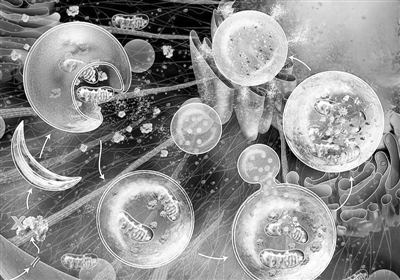
Autophagy is a measure for cells to save themselves by digesting some superfluous things in adversity, aiming at maintaining basic life activities.
Our reporter Fang Linlin
Interpretation of the 2016 Nobel Prize in Physiology or Medicine
The 2016 Nobel Prize in Physiology or Medicine was awarded to yoshinori ohsumi for his discovery of autophagy mechanism. This is an evolutionary conservative process, that is, eukaryotic cells can be partially recycled by transporting double-membrane vesicles to lysosomes. Different from other mechanisms of cell degeneration, autophagy can remove aging or damaged protein, macromolecular complexes and organelles, leaving room for participating in new physiological processes. In addition, autophagy is a key cellular process to remove invading microorganisms and toxic protein aggregates, so it plays an important role in fighting infection, aging and many human diseases.
Although autophagy was confirmed in the 1960s, in the following decades, scientists still knew little about its mechanism and physiological significance. Yoshinori ohsumi’s work has significantly changed people’s understanding of this important cellular process.
In 1993, yoshinori ohsumi published his pioneering discovery among 15 genes in yeast. Subsequently, he cloned these genes in yeast and mammalian cells and clarified the function of encoding protein. Based on yoshinori ohsumi’s pioneering discovery, the importance of autophagy in human physiology and diseases is now widely recognized.
Since the birth of the concept of autophagy, the research progress has been limited.
In the middle of last century, researchers found that there was a membrane structure containing degenerated cytoplasm in normal rat hepatocytes, but its abundance would be greatly increased after glucagon infusion or exposure to toxic substances.
In 1963, Christian Renede Duve coined the word "autophagy" after realizing that this structure has the ability to digest part of the contents of cells, and discussed this concept extensively in his published articles. A few years later, based on the observation results of electron microscope, scientists found that this autophagy also existed in mammalian cells.
Then, it was found that autophagy itself was at a low level, but it was aggravated during the differentiation and remodeling of various tissues including brain, intestine, kidney, lung, liver, prostate, skin and thyroid. It is speculated that autophagy may respond to hunger or disease. Besides autophagy in unicellular eukaryotes, this mechanism has also been found in metazoa such as amoeba, euglena, Tetrahymena, insects and frogs.
In the following decades, the progress in this field was limited. There are many indications that autophagy may be an important cellular process, but its mechanism and law are not well understood. In fact, the autophagy process is short-lived, and only exists in about 10-mdash; Within 20 minutes, this makes the related morphological and biochemical research very difficult.
Until the early 1990s, nearly 30 years later, many fundamental questions remained to be confirmed: How did autophagy start? How is autophagy formed? How important is autophagy to the survival of cells and organisms? What role does autophagy play in human diseases?
Autophagy mechanism found in yeast
Yoshinori ohsumi, an associate professor at the University of Tokyo, decided to use baker’s yeast as a model system to study autophagy. After checking that autophagy does exist in yeast cells, he developed a method to identify and identify the key genes involved in these processes. He named the first mutant gene autophagy gene 1(APG1), and then reported a series of genes that are essential for autophagy mechanism in eukaryotic cells, named APG1-APG15. With the identification of new autophagy genes in yeast and other species, ATG, as a gene abbreviation, has been used uniformly in subsequent academic research.
In the next few years, yoshinori ohsumi cloned ATG gene, and described the functions of a series of protein products, including proving in the laboratory that autophagy can participate in mediating the metabolic balance between the synthesis, degradation and reuse of cellular materials, and affect the biological life process, especially in response to hunger.
Yoshinori ohsumi’s pioneering research aroused scientists’ great interest in autophagy. This field has become one of the hottest fields in biomedical research, and the number of related publications has increased significantly since 2000.
Have a wide impact on health and disease.
The autophagy of molecules provides a new vision to understand the physiological process of cells, and it has gradually become an important way to understand various physiological and pathological States. The imbalance of autophagy mechanism is directly or indirectly related to human diseases, so it has become a particularly interesting scientific goal to apply autophagy mechanism to therapeutic intervention.
The first autophagy related to important diseases comes from the autophagy gene Beclin-1, which is the product of BECN1 gene, which is a homologue of yeast ATG6, and its mutation has caused breast cancer and ovarian cancer to a great extent. This discovery aroused great interest of scientists in autophagy in cancer.
Follow-up studies show that some recessive human chromosome diseases are related to impaired autophagy, which leads to brain malformation, developmental retardation, mental retardation, epilepsy, dyskinesia and neurodegenerative diseases. In addition, autophagy can eliminate invading microorganisms and is an important mechanism to activate immune response and control infectious diseases.