Have social networks brought us closer? No, it makes communication more restrained.
In the era of information explosion, when you wake up, it’s terrible that the full screen of little red dot always makes your heart scratch the wall. The inner os of patients with deep social fear: "three days visible" is a kind of interruption, it is best to be a "network vacuum person", or goodbye completely, social network.
When social media has quietly become an indispensable part of daily life, modern people are also surrendering their own data unnoticed. Nowadays, businesses that undertake the disappearance or tracking of the Internet have also emerged.People have to think about how to be wary of using their social accounts, or whether to simply escape.
"Connecting" is the tenet of Facebook. "Connecting people’s social vision is my top priority." Zuckerberg said before the hearing in April. At that time, tens of millions of Facebook users found that their private data had been leaked to Cambridge Analytica.
Studies have found that through close self-exposure, people become closer to each other. have onlyPeople have no privacy concerns about using these platforms in depth, and social media can make interpersonal communication so close.Paradoxically, these tools were created to keep people acquainted at a certain distance.
Julie Beck, senior deputy editor of Atlantic Monthly, recently conducted a study to try toVerify how much people look at themselves when using social media, and whether Cambridge analyzes whether corporate scandals have affected their use of Facebook and other platforms.Beck also shared the data with Sauvik Das, associate professor of interactive computing at Georgia Institute of Technology, and Sarita Schoenebeck, director of Living Online Laboratory at the University of Michigan. They also made some basic analysis of some data.
Of course, this survey is not rigorous. Atlantic Monthly sends the survey to readers through Facebook, Twitter, subscription mail and membership projects, so it is not a demographic sampling. Among the 2218 respondents, 82% are white, and most of them are from the United States; Women account for 59%, men for 40%, and 1% of other genders; Respondents are also distributed in a wide range of age groups, but generally tend to be older groups.
The survey results show what people are willing/unwilling to share on social media, the degree of trust in different platforms, and how privacy issues affect user behavior. In addition, Beck also followed up with some readers to learn their detailed views on social media privacy issues.
Overall, 78.8% of the respondents indicated that they were "very" or "somewhat" worried about their information privacy on social media; 82.2% said they would conduct self-censorship on social media. Das analysis mentioned that older people are more likely to conduct self-censorship because of privacy concerns than younger people, but for all age groups, the proportion is 75% or more. In this survey,"Self-censorship" is defined as "users will prevent themselves from publishing content they want to share for fear of privacy disclosure".
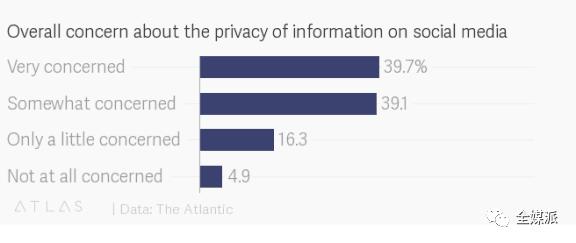
▲ Respondents’ concerns about the privacy of social media information
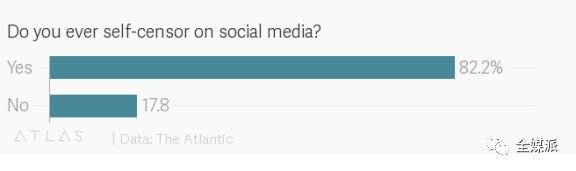
▲ Respondents conduct self-censorship when using social media.
David Garvey, a 27-year-old sales executive working in Boston, began to pay attention to self-censorship before Cambridge Analytica broke out. The reason is that David once posted a photo of drinking in high school on Facebook, and his friend’s mother complained to the principal after seeing it.
"Through that,I realized that anything posted on social media would be watched by others at any time."Garvey said," so I hardly send anything.Anything sent out may be publicly consumed.I try to avoid this situation,Keep your social life in intimate circles.Garvey said that he was not really worried about privacy on social media because he was careful enough about what he posted.
Among the respondents,Facebook is currently the most used but least trusted social network.57.9% of platform users said that they "almost don’t trust" Facebook or "don’t trust" Facebook’s protection of personal information privacy. Respondents have different attitudes towards other platforms such as Twitter, LinkedIn, YouTube, Pinterest and Snapchat. Most of them are neutral or uncertain, and Facebook’s Instagram has a higher degree of trust. Several interviewees said that they know that Instagram belongs to Facebook, but they feel that most of the pictures shared on Instagram are not so easy to be used.
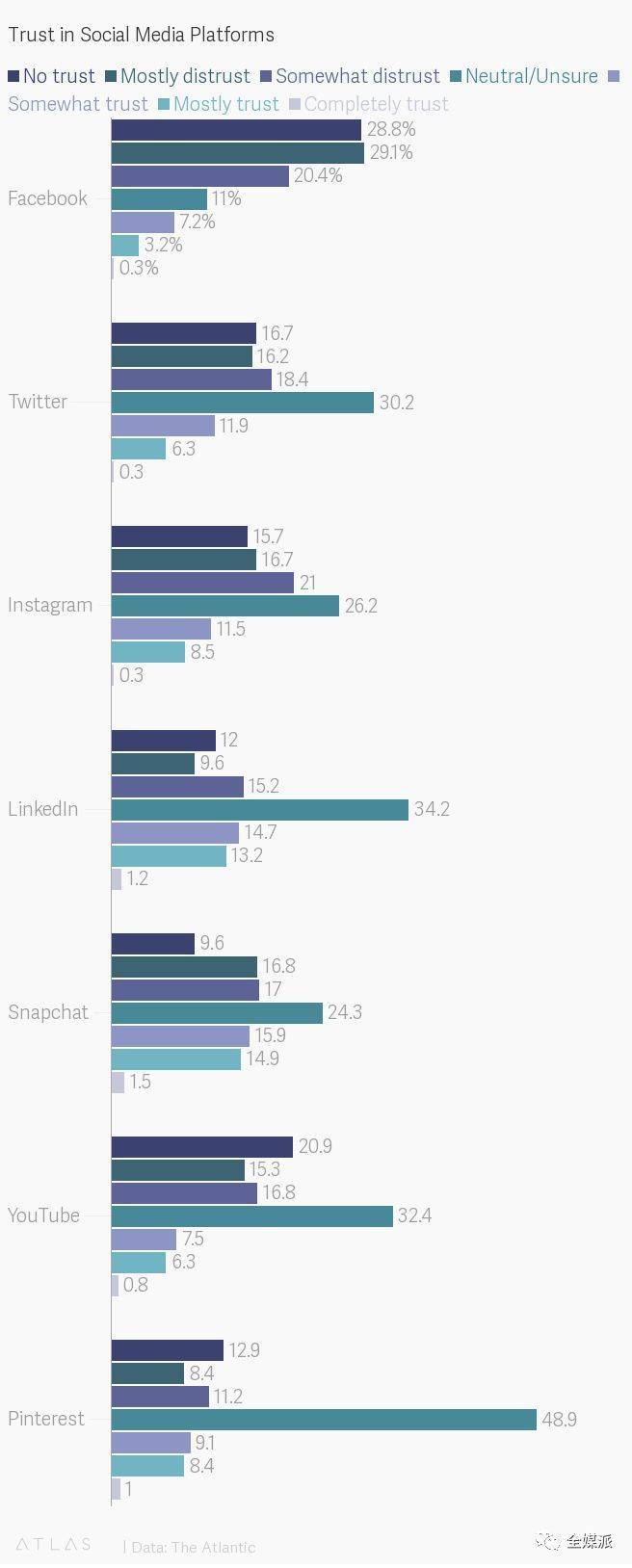
▲ Trust survey of major social media platforms
A Facebook spokesperson mentioned to Beck in an email that,In the past few months after the Cambridge Analytica scandal broke out in March, the company did not find any significant impact on user behavior."What we have seen is that people are more concerned about data privacy and understand their control and choice." In order to let users better "control" the privacy of their accounts, Facebook provides more concise privacy settings, and plans to develop a "history cleaning" function, so that users can delete data collected from external resources of Facebook.
However, some people began to think about how to use or whether to use Facebook after analyzing the company incident in Cambridge. In Beck’s survey, 99% of the respondents said they knew about the incident. Such a high proportion is certainly not unusual. After all, the survey was mainly aimed at readers of Atlantic Monthly, which paid close attention to this scandal. Among them,41.9% of people said that they changed their behavior of using Facebook because they knew this news, mainly because they were more careful about what they posted.But Das reminded,"When it comes to privacy, people often say one thing and do another."
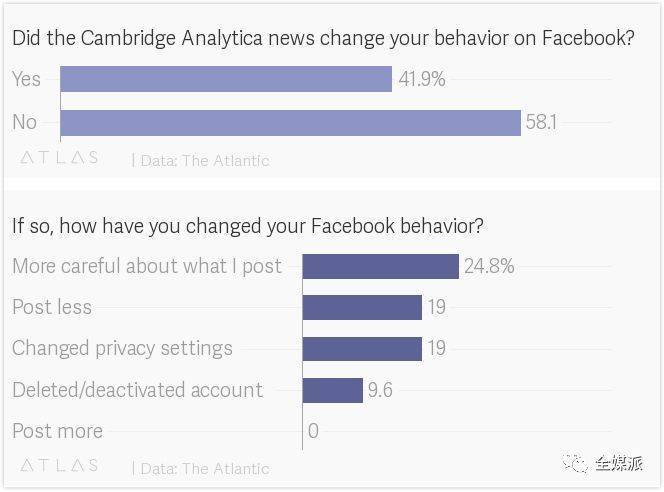
A small number of voices (9.6%) said that they deleted or frozen their Facebook accounts after the scandal broke out.After the Cambridge Analytica incident, Facebook refused to provide the average number of accounts that people freeze or delete every month.
Janice Riggs, a blogger in Chicago, deleted her Facebook account after hearing about the incident. "It’s just one thing I can get rid of in my life," she said. "I don’t use Facebook and I don’t believe it, so I just closed my account, and so did my husband. But I also know people who say that they will not really completely abandon Facebook. " In addition, Riggs also mentioned that it is still very troublesome to figure out how to delete Facebook account, and she finally searched a lot of operation guides on Google.
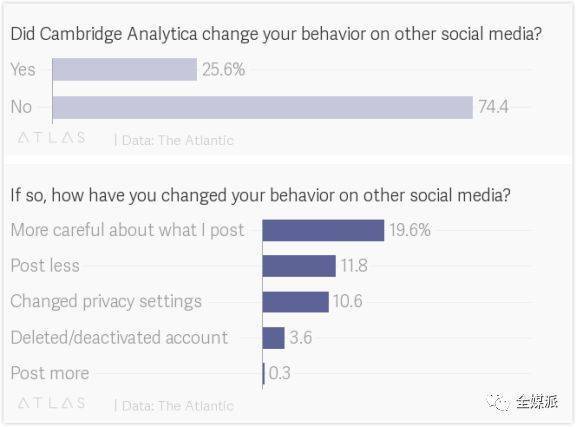
A small percentage (25.6%) said that theyAfter analyzing the company events in Cambridge, I changed my usage behavior on other social media platforms, mainly by becoming more careful, sending less things or changing privacy settings.
In addition to Cambridge’s analysis of the impact of corporate events, on the whole,Respondents said that the content they posted on social media was not as personal as it was five years ago.A total of 60% people said that the content they posted was "very impersonal" or "relatively impersonal", but 25.7% people remained the same.
In 2016, The Information reported that, at least on Facebook, original personal sharing (compared with emoticons or links) is decreasing. API)2015 survey by the American Journalism Institute (API) found that millennials pay more attention to privacy issues than in the past.
"I think people are increasingly accepting that social media is a part of life." Das said. This is also reflected in himself. Das found himself sharing work updates or major personal events on Facebook. "In the past, I only posted irrelevant content."
As the freshness of social media has passed and its practicality has become stronger, perhaps people will realize more and more that private information is the price paid when using social media. Of course, some people don’t care about it.
"If Facebook wants to extract my data to improve the whole algorithm, just do it." Garvey said, "I think this will bring net benefits to society. These data are valuable, and more constructive insights can be found from them, not harmful. "
"mark zuckerberg is a genius of Facebook," said Shirley O’Key, a 98-year-old retired teacher living in California. "He has admirable goals, and he wants to provide communication channels for the world. I have great confidence in his sincerity in doing these things. Of course, he was also blocked, because everyone said he didn’t protect his privacy. However, we should realize that nothing in the world is private. "
Maybe people are not ignorant, just confused for a while. Beck’s colleague Alexis Madrigal pointed out that,The development of Facebook will not be hindered. It has grown and is very important to the lives of too many people. No negative news can really affect it.Facebook is unique, at least in terms of necessity. In Beck’s survey, most Facebook users (68.6%) said that without Facebook, their social life would be "a little", "average" and "great". For other social media platforms, most people’s attitude is that social life without it will "not suffer at all".
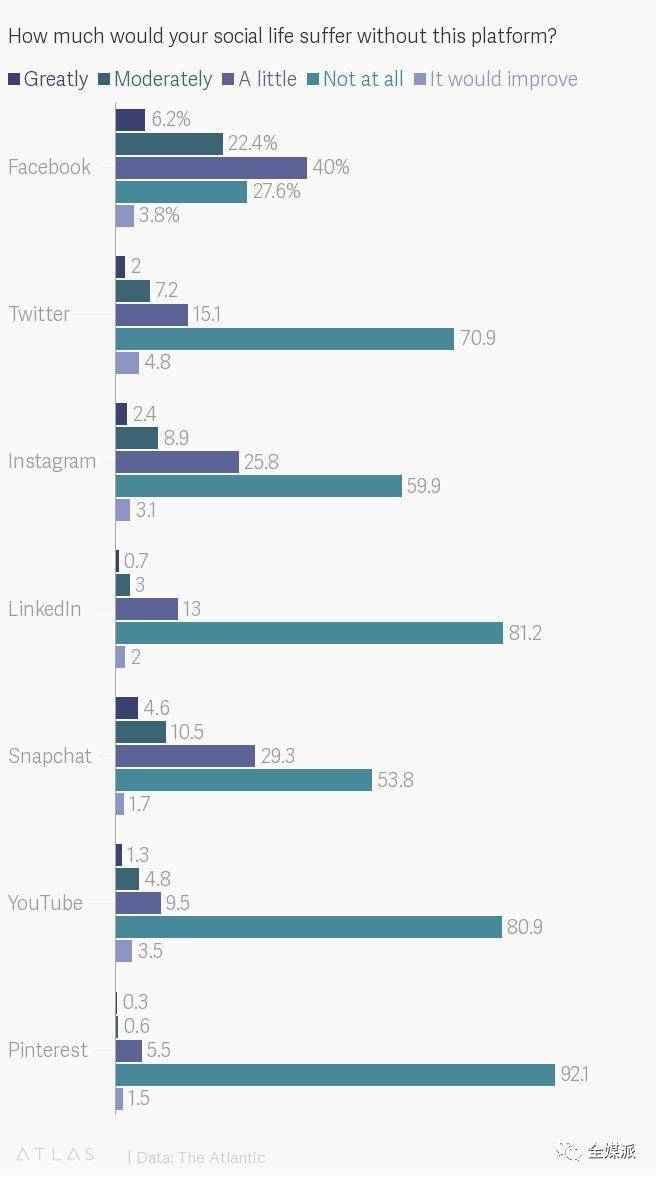
▲ "Without this platform, how much will your social life suffer?"
Regina Goodrich, a 26-year-old retail worker in Florida, said that she had frozen her Facebook account about five times in the past five years, but she couldn’t help but use it again. "I’m probably too afraid to miss something." Goodrich said. But recently, she completely deleted her account.It’s not because of Cambridge Analytica’s scandal, but because Facebook makes her feel too anxious. However, "privacy concerns are also one of the reasons."
However, in this survey, most people still reflect that they will not change their behavior of using social media because of this scandal.
Taylor Moore, a 22-year-old digital marketer in Chicago, said that Facebook is her "main social network" and she uses Facebook Messenger more than SMS. "If I have to delete some apps, deleting Facebook will definitely cause heavy losses." For Cambridge Analytica, Moore thought it was more like a "violation", and she didn’t change her usage habits because of it.
"The Cambridge Analytica incident is not the first time Facebook has fallen into a privacy storm." Schoenebeck said, "This kind of news has been breaking out for ten years. Every time we meet, people seem to think,’ This time it’s true, we must stay away from Facebook’. But then people forgot about it. Facebook is almost like a public tool, because people, especially adults, feel that they have to use it.So I don’t think people will associate using Facebook with trusting it.After all, many institutions and organizations are using it, such as workplaces, schools, community centers, churches, etc. People will miss many things if they don’t use it. "
Although the invasion of privacy will cause some people to completely quit some platforms, from a macro perspective, the dominant position of social media will not be shaken."It seems impossible to stop using the existing platform and return to the traditional social ways in the past." Das said, "We can’t stop using social media because they have completely changed the way we socialize, at least in this country."
On the contrary, if we continue to rely on social media to maintain relationships, then privacy violations that damage trust may lead to chilling effect. People will not give up social media, but they will use it more quietly, carefully and less personally. Social media is not a good tool for real connections.