The democratic concept of "change with the change of the people"

[Reading Classics Theory]

At the celebration of the centenary of the founding of the Communist Party of China (CPC), General Secretary of the Supreme Leader emphasized "developing people’s democracy in the whole process". The whole process of people’s democracy is real democracy, which reveals the essential characteristics of socialist democracy, that is, the people are the masters of the country; The whole process of people’s democracy is also concrete democracy, which is a summary of Socialism with Chinese characteristics’s theory and practice of people’s democracy. The discussion of democracy has always been an important aspect of Marxist classical writers’ in-depth thinking. Engels pointed out in his letter to Ai Bernstein on March 24, 1884 that democracy is not abstract and static, and "the concept of democracy … changes with the change of people every time". It can be seen that democracy should be concrete and historical. Reviewing Engels’ assertion can provide theoretical support for us to understand more accurately the vivid practice of people’s democracy in the whole process of contemporary China.

There is no abstract democracy in the world.

Engels specifically talked about the issue of "democracy" in his letter to Ai Bernstein: "Democracy … this’ concept’ changes with the changes of the people every time … In my opinion, it should be said that the proletariat needs the form of democracy in order to seize political power, but for the proletariat, this form, like all political forms, is just a means."

The word "democracy" in German means "the people are in power". Engels argued that the concept of the people is changing, so the concept of democracy should also change with the changes of the people. The proletariat has its own understanding of democracy, and those backward classes also have their own understanding of democracy. Engels pointed out that "if someone wants to regard democracy as an end today, he must rely on … those dying classes". Democracy here refers to bourgeois democracy. In the eyes of "those dying classes", bourgeois democracy is regarded as an end. For the proletariat, bourgeois democracy is not impossible for us, but it can only be regarded as a means, not as an end. The goal of the proletariat is to establish real democracy. As Marx and Engels pointed out in the communist party Declaration, seizing political power and striving for democracy are the first step of the proletarian revolution. "The first step of the workers’ revolution is to make the proletariat rise to the ruling class and strive for democracy". Only after the proletariat, through class struggle, breaks the bourgeois state machine in the revolution and establishes the dictatorship of the proletariat can a real democratic system be established.

Democracy and "people in power" are always concrete and historical, because the people here are always concrete and historical. In different historical periods, the people have different contents, including different classes, strata and groups. Marx said, "The state is an abstract thing. Only the people are concrete things. " Comrade Mao Zedong put forward more clearly: "There is only concrete freedom and concrete democracy in the world, but there is no abstract freedom and abstract democracy." Therefore, we can’t talk about democracy in the abstract, but we should distinguish the specific connotation of people and democracy.

The economic base determines whether people can be masters of their own affairs.

The concept of democracy changes with the changes of the people. Fundamentally speaking, this change is determined by the economic base. Lenin pointed out: "Any democracy, like any political superstructure (this superstructure must exist before the class is eliminated and the classless society is established), in the final analysis, it serves production and is determined by the production relations in that society." The concept of democracy changes with the changes of the people, and the people’s practical activities themselves are restricted by certain social and historical conditions, among which economic conditions play a primary and decisive role. In different production relations or economic systems, people’s practical activities and their functions are different, so the form of democracy varies with the economic base and people’s practical activities, and develops with their development.

Bourgeois democracy is based on capitalist private ownership. Therefore, although it is formally a "one-person-one-vote" electoral system, it is said that the "people" and the majority are the masters of the country, but in essence it only serves the dictatorship of the minority, that is, the bourgeoisie. As Lenin pointed out, "bourgeois democracy guarantees the equality of citizens regardless of gender, religion, race and nationality at any time and place, but it has never been implemented anywhere". Bourgeois democracy just "allows the oppressed to decide once every few years who will represent and suppress them in the parliament". Therefore, although bourgeois democracy has developed in line with the capitalist mode of production, it has played a certain progressive role in the development of human history. "But it is always a narrow, incomplete, hypocritical and deceptive democracy under the capitalist system, which is a paradise for the rich, a trap and a scam for the exploited and the poor." This form of democracy will eventually be replaced by socialist democracy.

General Secretary of the Supreme Leader pointed out that "the people are the masters of the country is the essence and core of socialist democratic politics". Socialism has eliminated the exploiting classes and enabled the overwhelming majority of the social population to be masters of their own affairs. Therefore, socialist democracy is the most extensive democracy that truly realizes the interests of the overwhelming majority of people in the history of human society.

The whole process of people’s democracy is the new development of socialist democracy.

The concept of democracy changes with the changes of the people. Only in the socialist stage, especially when the people can manage state affairs, economic and cultural undertakings and social affairs according to law through various channels and forms, and actually participate in all aspects of these democratic practices, can such people truly become the masters of the country, society and their own destiny, thus realizing real democracy. Lenin once reminded Russian revolutionaries that "proletarian or Soviet democracy does not focus on declaring the rights and freedoms of all people, but actually ensures that those working people who have been oppressed and exploited by capital can actually participate in state management." Lenin used two "realities" to emphasize that only by paying close attention to implementation can the people truly be masters of their own affairs. Ensuring and supporting the people to be masters of their own affairs is not a slogan or empty talk, but must be implemented in all aspects of national political life and social life.

Since the founding of New China, especially since the reform and opening up, the Communist Party of China (CPC) has United and led the people to successfully open up and adhere to the road of political development in Socialism with Chinese characteristics, and gradually implemented the requirements of the broadest socialist democracy. In November 2019, General Secretary of the Supreme Leader stressed during his inspection tour in Shanghai: "People’s democracy is a whole-process democracy, and all major legislative decisions are made through scientific and democratic decision-making in accordance with procedures and through democratic brewing." People’s democracy in the whole process not only adheres to and perfects the institutional requirements of socialist democracy for the participation subject and the comprehensive content, but also emphasizes the integrity of the actual participation process itself, so that the people’s subjective status is more respected and the people’s initiative spirit is better brought into play. The whole process of people’s democracy includes democratic election, democratic consultation, democratic decision-making, democratic management and democratic supervision. The General Secretary of the Supreme Leader pointed out: "Whether the people enjoy democratic rights depends on whether they have the right to vote in elections and whether they have the right to participate continuously in daily political life;" It depends on whether the people have the right to democratic elections and whether they have the right to democratic decision-making, democratic management and democratic supervision. Socialist democracy requires not only complete institutional procedures, but also complete participation in practice. " This important exposition points out that the whole process of people’s democracy emphasizes not only the complete institutional procedures, but also the complete participation in practice, the construction of the democratic system itself and the actual operation of the democratic system.This ensures that democracy in Socialism with Chinese characteristics is sustainable and can take root.

(Author: xingxing, a researcher at the Beijing Supreme Leader New Era Socialism with Chinese characteristics Thought Research Center and a researcher at the Marxist Text Research Center of the School of Philosophy of Beijing Normal University)

What needs to be done to make more elderly people enjoy digital convenience?

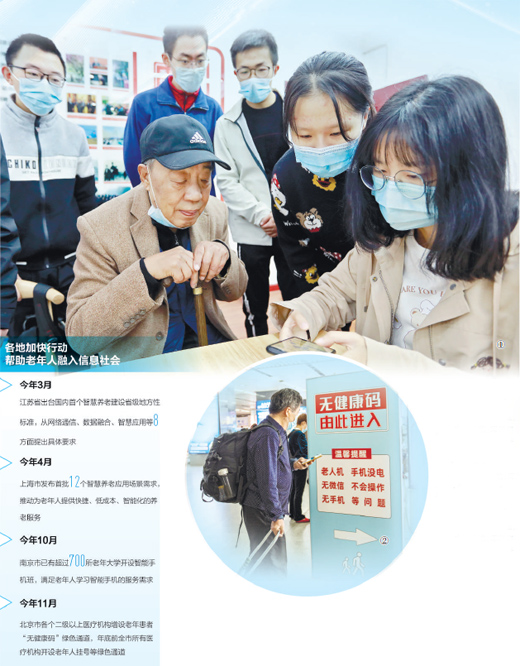
Figure ①: Recently, students from Xi ‘an Jiaotong University Student Association are helping the elderly to learn how to operate smart phones. People’s visual map ②: Wuxi Railway Station in Jiangsu Province opened a service channel without health code to provide convenient services for the elderly. People’s vision

  Online booking registration, scanning code to pay for goods, and online car travel … … With the rapid development of mobile Internet, digitalization has profoundly changed people’s daily lives, but at the same time, it has also made some elderly people feel at a loss — — I can’t scan the health code and wander at the door of the community. I don’t need mobile payment to worry at the checkout counter. I won’t make an online appointment to go to the hospital and I can’t hang up the number … …

  China has stepped into an aging society. According to the forecast of the Ministry of Civil Affairs, the elderly population in China will exceed 300 million during the 14th Five-Year Plan period. On the one hand, it is an increasingly prominent aging phenomenon, and on the other hand, it is a rapidly developing digital society. How can the elderly keep up with the times and enjoy the dividends of scientific and technological progress?

  The General Office of the State Council recently issued the "Implementation Plan on Effectively Solving the Difficulties of the Elderly in Using Intelligent Technology", which made arrangements for further solving the difficulties encountered by the elderly in using intelligent technology, adhering to the parallel of traditional service methods and intelligent service innovation, and providing more comprehensive, intimate and direct convenience services for the elderly.

  What specific difficulties do the elderly currently face in using intelligent technology? Let them better adapt to and integrate into the smart society, what other aspects need to be exerted? The reporter conducted an investigation and interview on this.

  The elderly have accelerated their "touching the net" and become a group of network users that cannot be ignored.

  Continuously optimized smart devices and network services make life more convenient and fun for the elderly.

  "Small degree, turn on the bedside light belt." As soon as the voice fell, light appeared in the dark night. This is the Yanshou Community Pension Service Station in Dashilan Street, Xicheng District, Beijing. Last summer, relying on Baidu artificial intelligence products such as "small smart screen", 71-year-old grandma Fang Kejie intelligently transformed her residence.

  Click Bluetooth with one click to automatically connect devices. Fang Kejie, while skillfully operating, told reporters: "In the past, I always looked for my mobile phone in the dark before getting up at night, and turned on the light by the screen light. It was inevitable that I would bump into it when I was old. Now that you have a smart speaker, you can light the bedside lamp by moving your mouth, which is particularly convenient! "

  "The registered population of Dashilan Street accounts for nearly 30% of the elderly over 60 years old, far exceeding the national average of 18.1%." Ma Naiqi, director of the "Silver Crane Zero Distance" Overall Dispatching Center in Dashilan Street, said that the simple mobile phone operation for ordinary people will become more complicated for the elderly. With the help of artificial intelligence products such as intelligent control lights, you can make an appointment for nutritious meals and get health information, so that the elderly can better enjoy the convenience and fun of intelligent life.

  At home, the ever-changing smart devices make the elderly more comfortable; Going out, continuously optimized software services also make the elderly more worry-free.

  Walking into a community in Haidian District, Beijing, Aunt Xin, who was strolling in the community after dinner, was surrounded by several neighborhoods who were both in their 60s. When she got closer, it turned out that she was introducing her online registration experience to everyone — — Open "Jing Yi Tong" WeChat WeChat official account, select "Medical Service", click "Register", fill in the list of hospitals and the date of medical treatment, and finally the online payment is completed.

  "It’s so convenient, we have to try it!" The neighbors were amazed. Aunt Xin said that she used to queue up at the hospital at 5 o’clock in the morning, but now she can register on WeChat without leaving home. After tasting the sweetness of "touching the net", now I go to the market to buy food and go to the supermarket to shop. Aunt Xin has also joined the "cashless family". "With a light sweep, I can pay on the code!"

  Older people enjoy digital life and take more actions on the road. In Nanjing, Jiangsu Province, more than 700 universities for the elderly have set up smart phone training courses to teach the elderly to learn how to pay by scanning code and register online. Since its opening, the number of applicants has almost been full. In Jiaxing, Zhejiang Province, State Grid Power introduced the chip into smart plug, and the electricity consumption can be checked in real time through the mobile APP, which is convenient for the elderly to handle abnormal situations in time; A number of network platforms have launched formats specially designed for the elderly, and large fonts make the elderly no longer have reading disabilities … …

  At present, with smart phones as the entrance, more and more elderly people are stepping into a new life of "mobile internet". According to Tencent’s Mobile Internet Report for Elderly Users, since 2012, the number of mobile Internet users in China has increased by 79%, and the number of elderly Internet users has increased by 130%. The speed at which the elderly touch the Internet is 1.6 times that of the overall mobile Internet popularization. In the use of apps, about 50% of elderly users downloaded more than 30 apps, including not only shopping and square dancing, but also financial stocks and securities, TV shopping sales, social security medical care and old-age care.

  Entering the overlapping period of digitalization and aging, it is more and more important and urgent for the elderly, as a group of network users that can not be ignored, to meet their growing demand for information use and public services — —

  "With the widespread use of information tools in society, the popularization of information technology will be a necessary condition to ensure the elderly to participate in social activities." Zhu Lihua, head of the Research Center for Smart, Healthy and Aging of Qingdao University, said that research shows that for the elderly, the Internet and social media can play a role in close communication with relatives and friends, promote social integration, improve healthy habits, enhance self-care ability and subjective well-being, and help to achieve a happy old age.

  The significance of the elderly "touching the net" does not stop there. Liang Ma, a professor at the School of Public Administration of Renmin University of China, believes that breaking the consumption barriers of the elderly in the digital world will help release the consumption potential and greatly promote the development of e-commerce and digital economy.

  In the longer term, letting the elderly enjoy digital convenience will also promote technological innovation in the opposite direction. According to Feng Wenmeng, a researcher in the Social Development Research Department of the State Council Development Research Center, with the increasing number of elderly people, they will become an important service target for future product development, and technological innovation around the elderly group will become a new blue ocean for enterprises to participate in market competition.

  It is convenient for the elderly to "touch the net" and break the obstacles of digital life for the elderly.

  Increase the aging transformation of product technology to alleviate the anxiety of the elderly about new technologies.

  In recent years, China’s Internet has continued to penetrate into the elderly population, but compared with the increasing number of elderly people, the current proportion of the elderly people surfing the Internet is still low, and many of the elderly who have "touched the Internet" cannot enjoy the digital life.

  Where are the obstacles?

  "The information barriers of the elderly mainly exist in three levels: access level, whether access services can be obtained; On the skill level, whether the software and hardware of information products will be used; At the content level, can you search, identify, use and manage relevant information on demand? "

  Zhu Lihua analyzed that with the improvement of network infrastructure and the improvement of the consumption ability of the elderly, the current problems mainly appear at the skill level and content level.

  On the one hand, the current technology and services are not friendly enough for the elderly, and it is difficult to meet the aging needs.

  "Most of the products and services on the market are developed for the younger generation, and the needs of elderly users are not fully considered in the design concept." Wanglili, deputy director of the Institute of Aging Economy and Industry of China Aging Science Research Center, said, for example, the current mobile phone touch screen can’t provide a better touch feeling than physical buttons; In the interface interaction, it is mostly visual-oriented, lacking physical feedback, which increases the error rate and frustration of the elderly.

  In this regard, Uncle Wang, a retired professor at Hongxing Community in Kunming, Yunnan, was deeply touched: "The words on the smart phone are too small to be seen without reading glasses, and there is only one screen. Sometimes I can’t find where the buttons are and I don’t know how to unlock them."

  From the perspective of public services, compared with the construction of environmental accessibility, all sectors of society pay less attention to the information accessibility of the elderly. Wanglili said that in some places, when providing related services, they failed to fully adjust to aging. For example, they had to make an online reservation to book tickets in advance, refused to buy things in cash, and only provided a code-scanning travel channel, which made the elderly feel at a loss and difficult to adapt.

  On the other hand, the elderly themselves have physiological dysfunction, and they are prone to anxiety in the face of new technologies.

  In Guangming Community, Shushan District, Hefei City, Liu Li, who founded a smart phone training class, bluntly said that the elderly "classmates" have strong acceptance but are forgetful, and the two-hour course can usually only train one function.

  Not only that, industry insiders analyzed that when facing smart devices such as computers and mobile phones, the elderly are always worried that they will damage their products by misoperation or be cheated by the Internet, which makes them often feel anxious when accepting new technology products.

  This was confirmed in an interview with reporters. Although she is now a "network expert" in the community, Aunt Xin admits that at the beginning of her "touching the net", she always felt that the Internet was full of traps, fearing that mobile payment would be bound to a bank card, and the money on the card would be transferred away by others. After my son’s constant persuasion and repeated training, I was relieved to integrate into online life step by step.

  In Zhu Lihua’s view, a good social environment for the elderly to participate in digital life has not yet been fully formed. The elderly have great individual differences, and their physical condition, psychological state, hobbies, past experiences and other factors will affect their attitude and behavior towards the Internet. All sectors of society have little understanding and concern about the difficulties encountered by the elderly in the information society at this stage.

  "From the supply side, the information barrier-free industrial system and market effect for the elderly have not yet been fully formed, and it is difficult for related enterprises to make profits, resulting in fewer end products that can be used by key beneficiary groups and are cost-effective and easy to operate, and the effective supply in the market is obviously insufficient." The relevant person in charge of the Information and Communication Administration of the Ministry of Industry and Information Technology said.

  The information barrier-free construction has achieved remarkable results, alleviating the contradiction between supply and demand of digital life for the elderly.

  Efforts should be made to improve market supply, optimize public services, and unite various forces.

  It is the proper meaning of building an information society in an all-round way to better ensure the convenience of the elderly to participate in online life. In recent years, letting the elderly enjoy digital life is gradually attracting the attention of all walks of life. In 2015, the State Council issued the "Guiding Opinions on Actively Promoting the" internet plus "Action" and proposed "building a network platform for old-age information services"; In 2017, the Ministry of Industry and Information Technology, the Ministry of Civil Affairs and other ministries and commissions jointly issued the Action Plan for the Development of Smart and Healthy Pension Industry (2017— 2020), detailed planning of the road map for the development of smart pension products and services … … The successive introduction of various policies has alleviated the contradiction between supply and demand of digital life for the aged to some extent.

  "After several years of development, the information barrier-free construction for the elderly has achieved positive results." According to the relevant person in charge of the Information and Communication Administration of the Ministry of Industry and Information Technology, since 2013, more than 800 government units have built information accessibility service platforms, and 32,000 government websites have achieved information accessibility. In addition, relevant departments organize some social communication, online shopping, life entertainment, news and information apps to carry out barrier-free transformation, which brings a lot of convenience for the elderly to obtain information.

  Scholars and market participants interviewed believe that the following points should be grasped to adapt to the trend of population aging and social informatization and realize the goal of "information accessibility" for the elderly:

  — — Improve market supply, guide enterprises to fully consider the needs of the elderly, and develop more high-quality and aging-suitable digital products.

  Zhu Lihua suggested that market players should make great efforts to collect, analyze and excavate the demand of digital products and services for the elderly, deeply study the physical and psychological changes of the elderly, develop aging digital products, and accurately optimize the quality of products and services.

  "For example, smart phones should consider diversified needs in the general design, so that elderly users can also choose products and services that are easy to accept and use." Wanglili said.

  "The next step will continue to play the guiding role of the government and cultivate diversified market players in the elderly intelligence industry." According to the relevant person in charge of the Information and Communication Administration Bureau of the Ministry of Industry and Information Technology, the Ministry of Industry and Information Technology is currently working with relevant industry authorities to give preferential treatment to enterprises that have made outstanding contributions to information barrier-free construction in rating evaluation, credit management and social responsibility assessment, so as to further mobilize the enthusiasm of enterprises. Experts believe that the relative profit of digital products and services for the elderly is relatively low, and fiscal and taxation policies should support and encourage them.

  — — Optimize public services, give consideration to traditional and emerging lifestyles, and set aside special service channels for the elderly.

  "With the rapid development of information technology, the needs of different groups should be integrated, and traditional and emerging lifestyles should coexist for a period of time." Feng Wenmeng believes that before using digital means to facilitate the lives of the elderly, we must first ensure that their lives are barrier-free, and we must retain traditional channels as a transition to help them gradually move towards emerging channels. "In particular, the public service department should leave a window for offline services for the elderly, and traditional methods familiar to the elderly, such as offline customer service, manual telephone calls and paper forms, should be retained in due course."

  In addition, the public service department can try to refine the service. For example, record the corresponding tutorial videos for different scenes, teach the elderly to learn how to handle the corresponding online business, alleviate the anxiety of the elderly who don’t know where to start, and also reduce the pressure of offline windows.

  In recent years, it has gradually become a fashion to open special passages for the elderly. Jiangsu Wuxi Railway Station has set aside special channels for manual services for passengers who use old man-machine and can’t use WeChat. Many hospitals in Chaoyang District, Beijing have added a new channel &hellip to verify the health status of elderly patients who can’t show their health codes. … All these make the old people travel more smoothly.

  — — Cohesion of various forces, relevant organizations, communities and families do their best to help the elderly groups keep up with the times.

  "There are a variety of intelligent application scenarios in life, which increases the complexity of the participation of the elderly to a certain extent. It is necessary for multiple subjects involved in the lives of the elderly to do their best and take a multi-pronged approach." Zhu Lihua said.

  At the community level, Ma Naichi suggested that various forms of training lectures and on-site classes should be actively organized to provide channels for the elderly to learn new technologies and new products. At the same time, more psychological counseling should be given to the elderly to guide them to actively change their concepts and dare to accept new things. "Relevant departments may wish to support and guide enterprises to increase relevant services by increasing the government’s purchase of services, so as to facilitate the elderly to learn network technology." Wanglili said.

  Family efforts are also essential to help the elderly better integrate into the digital society. Zhu Lihua said that on the one hand, young people should use "technology" to feed back the elderly, so that the elderly can have more confidence in learning smart phones; On the other hand, we should also create opportunities to encourage and accompany the elderly to apply digital products and accompany them to learn the necessary digital life skills with more patience.

The Ministry of Commerce responded to the EU’s proposal to impose temporary anti-dumping duties on biodiesel imported from China.

  Xinhua News Agency, Beijing, July 25th (Reporter Tang Ningning, Xie Xiyao) He Yong, spokesman of the Ministry of Commerce, said on July 25th that China had noticed that the European Commission released the preliminary findings of its anti-dumping investigation on biodiesel in China on July 19th, and proposed to impose provisional anti-dumping duties on biodiesel imported from China. China is highly concerned about the protectionist actions of the European side in the biodiesel industry.

  Recently, the European Commission announced that it would impose a temporary anti-dumping duty of 12.8% to 36.4% on biodiesel imported from China. In this regard, He Yongqian responded at the regular press conference of the Ministry of Commerce held on the 25th that China has always advocated the rational and prudent use of trade remedy measures, and urged the European side not to rashly adopt trade protectionist measures and resolve mutual concerns with China through dialogue and consultation.

  "The EU is the world’s largest consumer of biodiesel. The import of biodiesel from China is to meet the huge consumer demand in the EU market and accelerate the realization of its own green transformation and energy conservation and emission reduction goals." He Yongqian said that China has repeatedly stressed that European taxation measures will only raise the cost of related products, harm the interests of related industries and consumers in the EU, and undermine the EU’s green transformation process and the overall situation of China-EU economic and trade cooperation.

The full text of the "Interim Measures for the Special Supervision of Safety Work in Primary and Secondary Schools (Kindergartens)"

  CCTV News:A few days ago, the Office of the State Council Education Steering Committee issued the Interim Measures for Special Supervision of Safety Work in Primary and Secondary Schools (Kindergartens) (hereinafter referred to as the Measures). The "Measures" pointed out that the prevention and response of key issues such as drowning prevention, traffic accidents, school bullying and violence, school-related and student-related crimes, psychological and behavioral counseling and correction will be mainly supervised by relevant functional departments, primary and secondary schools.

  The Measures consists of 5 chapters and 19 articles, mainly including five aspects: general principles, supervision contents, organization and implementation, application of results and supplementary provisions, which systematically designs and comprehensively stipulates the special supervision of school safety. The following is the full text of the Measures:

Office of the State Council Education Steering Committee on Printing and Distributing
"Special supervision of safety work in primary and secondary schools (kindergartens)
Notice of the Interim Measures

  State religion supervision [2016] No.4

  General offices of the people’s governments of all provinces, autonomous regions and municipalities directly under the Central Government:

  In order to implement the general requirements of the CPC Central Committee and the State Council on ensuring school safety, promote the establishment of a scientific, standardized and institutionalized safety guarantee system and operating mechanism for primary and secondary schools (kindergartens), and improve the ability to prevent and control safety risks, the Interim Measures for Special Supervision of Safety Work for Primary and Secondary Schools (kindergartens) are formulated. Is issued to you, please seriously implement the actual.

  The State Council Education Supervision Committee Office

  November 30, 2016

  Interim Measures for Special Supervision of Safety Work in Primary and Secondary Schools (Kindergartens)

  Chapter I General Principles

  the first In order to implement the general requirements of the CPC Central Committee and the State Council on strengthening school safety, and urge all localities to conscientiously do a good job in the safety management of primary and secondary schools (kindergartens) (hereinafter referred to as schools), these measures are formulated in accordance with the Regulations on Education Supervision and relevant national policies and regulations.

  the second The special supervision of school safety work is an important measure to promote local governments and relevant functional departments and schools to establish a scientific, standardized and institutionalized safety guarantee system and operation mechanism, and to improve the ability of school safety risk prevention and control.

  Article The State Council Education Steering Committee Office is responsible for the special supervision of provincial school safety work, and the education supervision institutions of provincial, municipal and county people’s governments are responsible for the special supervision of school safety work at the next level and within their respective jurisdictions.

  Article 4 The implementation of special supervision of school safety work should adhere to the following principles:

  (1) Unified leadership. Effectively strengthen organizational leadership and overall coordination, regard school safety as an important part of the comprehensive management of public safety and social security, and conduct regular supervision and inspection.

  (2) Pay attention to practical results. Improve the form, content and methods of special supervision of school safety work, adjust measures to local conditions, and ensure the effectiveness of special supervision of school safety work.

  (3) Openness and transparency. Adhere to the openness of standards and methods, organizations and personnel, processes and results, and actively accept social supervision.

  Chapter II Supervision Contents

  Article 5 Organization and management

  (a) the provincial people’s government to establish and improve the organization and management system of school safety work, and urge the municipal and county governments to implement the responsibility of school safety management and supervision.

  (two) the relevant functional departments to implement the funds and resources for school safety work, to carry out safety management training and guidance, and to supervise the establishment and improvement of safety management institutions, the implementation of post safety responsibilities, and the provision of security personnel.

  Article 6 System construction

  (a) the provincial people’s government to implement the national laws, regulations, rules and standards related to school safety work, establish and improve the governance mechanism of school safety work, formulate and improve the local school safety standard system, and carry out school safety certification.

  (2) The relevant functional departments shall carry out their respective duties, make concerted efforts, improve the supervision and management of school safety work, strengthen the comprehensive management of school and surrounding safety, and establish a student safety area.

  (III) The school shall establish and improve the safety management system and safety emergency response mechanism, and implement all aspects and post responsibilities of civil air defense, physical defense and technical defense construction and safety management in accordance with the requirements of the Code for Safety Prevention in Primary and Secondary Schools and Kindergartens (Trial).

  Article 7 Early warning and prevention

  (a) the relevant functional departments to establish a school safety early warning mechanism for the investigation and remediation of hidden dangers, and timely release the safety early warning announcement.

  (two) the relevant functional departments to develop a list of school safety risks, to carry out school safety inspection and dynamic monitoring, timely analysis and evaluation of safety risks, put forward early warning information.

  (three) the school to establish and implement safety education, daily management, sports, extracurricular activities, public safety incidents, school bus safety, food safety, health and epidemic prevention, natural disaster risk assessment and prevention.

  Article 8 Educational drills

  (a) the education department in accordance with the "guidelines for public safety education in primary and secondary schools" to guide schools to strengthen safety education, implement safety education into the classroom, and ensure the funds, teaching resources and teachers required for safety education.

  (two) the relevant functional departments to guide and participate in school safety education, to carry out security activities into the campus.

  (3) The school conducts safety education in accordance with the Guidelines for Emergency Evacuation Exercises in Kindergartens in Primary and Secondary Schools, and regularly organizes emergency evacuation drills such as earthquakes and fires.

  Ninth key governance

  (a) the relevant functional departments to strengthen the prevention and response to key issues such as drowning, accidents, student bullying and violence, timely make special reports and statistical analysis, and guide the school to perform its education and management duties.

  (two) the education department in conjunction with the public security departments in a timely manner to crack down on illegal and criminal acts involving the safety of schools and students, maintain the normal order of education and teaching, and build a safe campus.

  (three) education departments and schools to improve the protection system for the rights of underage students, to prevent, investigate and deal with incidents that infringe on the physical and mental health of underage students, and to carry out psychological and behavioral counseling and correction activities.

  Article 10 Accident handling

  (a) the provincial people’s government to establish and improve the school safety accident response, handling and accountability mechanism.

  (two) the relevant functional departments timely organize the implementation of rescue, the implementation of accident investigation, responsibility identification and after-care treatment, and investigate the administrative and criminal responsibilities of the accident-related units and responsible persons.

  (three) the education department and the school properly handle the disputes over safety accidents and maintain the normal education and teaching order of the school.

  Chapter III Organization and Implementation

  Article 11 Daily supervision. Give full play to the role of responsible inspectors, strengthen daily inspections, and promote the orderly work of school safety.

  Article 12 Local self-examination. The provincial people’s government and relevant functional departments shall conduct self-examination according to the index system, and publicize the self-examination report on the websites of local governments and provincial education administrative departments, and submit it to the the State Council Education Steering Committee Office after the expiration of the publicity period.

  Article 13 Field supervision. According to the daily supervision and local self-examination, the Office of the State Council Education Steering Committee compiled the detailed rules for the implementation of on-site supervision, randomly selected inspectors and experts to form a supervision team, randomly determined the objects of supervision, and carried out on-site supervision by listening to reports, consulting materials, focusing on inspections, random checks and individual interviews.

  Article 14 Publish a report. The State Council education steering committee office according to the provinces (autonomous regions and municipalities) self-evaluation and field supervision results, the formation of special supervision opinions and supervision reports, supervision reports released to the public.

  Article 15 Rectification and implementation. The supervised provinces (autonomous regions and municipalities) shall actively carry out rectification according to the rectification requirements and suggestions after receiving the supervision opinions of the supervision team, and report the rectification in writing to the the State Council Education Steering Committee Office within 3 months. Major safety hazards that need immediate rectification shall be reported to the the State Council Education Steering Committee Office within one month.

  Chapter IV Application of Results

  Article 16 The Office of the State Council Education Steering Committee has established a work accountability mechanism, taking the results of special supervision as an important content to evaluate the effectiveness of government education, giving informed criticism to areas where the responsibilities are not in place, and accountability to areas where school safety work is ineffective or there are serious problems.

  Article 17 To investigate and deal with the serious accidents of school safety responsibility, serious violations of law, discipline and rules in school safety work, in accordance with laws, regulations and relevant regulations. Clues about violations of discipline are handed over to the discipline inspection and supervision organs for investigation, and the responsibilities of relevant units and responsible persons are seriously investigated. Suspected of a crime, transferred to judicial organs for handling according to law.

  Chapter V Supplementary Provisions

  Article 18 The provincial people’s government shall, in accordance with these measures, formulate the implementation plan for the special supervision of school safety work in this province.

  Article 19 These Measures shall come into force as of the date of promulgation.

The Fifty-second Theory of Digital Expo: Big Data —— "New Engine" for High-quality Development

  Cctv news: At the opening ceremony of 2018 China International Big Data Industry Expo, the General Secretary of the Supreme Leader personally sent a congratulatory letter. The congratulatory letter clearly pointed out: "Focusing on building a network power, a digital China and a smart society, fully implementing the national big data strategy will help China’s economy shift from high-speed growth to high-quality development." The General Secretary profoundly analyzed the current situation and trend of big data development, put forward clear requirements for implementing the national big data strategy and accelerating the construction of digital China in light of China’s actual situation, actively pointed out the direction for the strategy of making good use of big data and winning the development of the new era, and marked that the Digital Expo and Guizhou’s big data development career stood at a new starting point and entered a new journey.

  Big data drives high-quality development

  Data is the new oil and the most precious property in this century. "whoever has the data will have the initiative." As the first national-level big data comprehensive experimental zone in China, from 2013 to 2018, Guizhou has won the status of a pioneer with innovation among the provinces in the country, from scratch, to take root, and then to the wind and water. Guiyang, a "provincial capital city with no sense of existence", has achieved phoenix nirvana with big data in a few years, making the world sit up and take notice. In 2017, Guiyang proposed to build a "China Valley" to create an upgraded version of big data development. In 2018, Guiyang issued an implementation opinion, taking the development of digital economy as a new engine to accelerate the conversion of old and new kinetic energy and promote high-quality development. The butterfly change in just a few years has become a huge gravitational field. Here, the epitome of "Digital China" is converging.

  "Everything can be digitized", which promotes quality change and creates unlimited opportunities for integrated development. In recent years, Guiyang has taken the information infrastructure construction as the support, the promotion of data convergence as the basis, the Internet and big data as the focus, the informationization and digital transformation as the core, and the "introduction of thousands of enterprises" and "transformation of thousands of enterprises" as an important starting point to accelerate the transformation and upgrading of traditional enterprises.

  By the end of 2018, Guiyang had implemented 589 integration projects with a total investment of 38.08 billion yuan, launched 36 provincial-level benchmarking projects and 300 municipal-level integration demonstration projects, and organized the evaluation of the integration degree of 3,569 enterprises. Guiyang has promoted the integration of big data and the real economy, and the transformation of old and new kinetic energy has continued to accelerate, which has promoted the integration and upgrading of tourism, commerce, logistics, finance, transportation and other industries in the city to a platform-based, intelligent and shared type.

  Big data improves quality and efficiency to achieve dynamic change.

  Big data is like a catalyst. Wherever it goes, it will cause amazing changes and efficiency changes. As the main battlefield for poverty alleviation in the country, Guiyang has promoted agricultural quality improvement and efficiency improvement through big data information technology, deepened the rural industrial revolution through "big data+agriculture", and made big data run through all aspects of agricultural planting, transportation and sales, improving the digitalization, precision and intelligence of agricultural production. At present, China is in a critical period of the conversion of old and new kinetic energy. Big data is an important means to promote the conversion of old and new development kinetic energy. Through deep integration with traditional industries, big data runs through all aspects of production, circulation, sales and service of traditional industries, in order to achieve high-quality development. Inject new kinetic energy.

  Practice the "people-centered" development concept, make good use of big data to benefit the people and solve their worries, so that the people can have more "gain" from the development of big data, and then promote dynamic change. With the help of big data, such visions and actions are gradually turning into concrete and sensible convenience scenes by promoting the "convergence of big data and government services" and "doing everything in one door and doing things in the whole province in one network".

  In multi-dimensional application scenarios, people are no strangers to big data, but efforts to break down barriers are still indispensable to fully tap the powerful driving force of big data. Guiyang is vigorously implementing high-level opening-up and accelerating high-quality economic development. Only by realizing the "convergence" of big data in concept cognition and system design, and stirring a pool of spring water with the "fusion" and "use" of big data, can big data truly become a starting point for practicing new development concepts and promoting high-quality development.

  Big Data Leads Industry Digitalization

  General Secretary of the Supreme Leader pointed out in the report of the 19th National Congress of the Communist Party of China that "promoting the deep integration of Internet, big data, artificial intelligence and real economy" is a major strategic choice made by the CPC Central Committee based on the overall situation and facing the future, which is of great significance and provides us with fundamental follow-up.

  Guizhou is the first national big data comprehensive experimental zone, and it has also been awarded the "golden signboard" of Guiyang National Big Data Industry Cluster and Big Data Technology Innovation Experimental Zone. Guizhou Province undertakes the heavy responsibility of exploring the national big data strategy, and Guiyang also shoulders the responsibility of creating big data development concepts, systems and initiatives. From 2014 to the present, this city located in the southwest has overcome difficulties and held high the banner of big data development, catching up and leaping forward all the way, singing the strong voice of big data development, and completed the gorgeous turn from "the old and the young are poor" in the western mountain city to "China is counting the valleys". This low-key western capital city has now been full of vitality.

  Guiyang regards the deep integration of big data and real economy as the main direction of big data development, vigorously promotes the application of big data technology in various scenarios, leads three industrial transformations and upgrades with big data, improves the quality and level of supply system, and promotes the real economy to move towards high-end, intensive and green. According to the overall report on the development of big data in Guiyang in 2018, the main business income of big data enterprises in Guiyang reached 100 billion yuan in 2018, an increase of 22.4%; The revenue of full-caliber software and information technology service industry was 28 billion yuan, up by 23.5%, of which 5 million caliber was 14 billion yuan, up by 27.3%; Software service outsourcing and call center industry realized business income of 5.02 billion yuan. 51 new big data enterprises were added, with a total of 208; 82 new big data industry projects were signed, with a total investment of 19.496 billion yuan.

  In recent years, the construction of Guizhou National Big Data Comprehensive Experimental Zone has been deepened, the integration of big data and real economy has been accelerated, the opening of government data sharing has been accelerated, and the construction of new formats and new models of big data has been accelerated. The development of big data in Guizhou has entered a new stage and stepped onto a new level. Statistics show that 2016— In 2018, the integration index of industrialization and informatization in Guizhou rose by six places in the national ranking, and the first index evaluation system for the deep integration of big data and real economy in China was established. In 2018, the GDP of Guiyang increased by 9.9%, and the economic growth rate ranked first in the provincial capital cities for many years.

  Good wind, with its strength, sent me to Qingyun. From the aspects of big data policy, platform, capital, technology, talents, brand, industrial upgrading, state support, application creation, practice and project operation, today’s "experimental field" in Guiyang, Guizhou has gradually changed from "nothing" to ∞ " , has taken shape. Under the guidance of the spirit of the important instructions of the Supreme Leader General Secretary and the spirit of congratulatory letter, keeping the two bottom lines of development and ecology and making good use of the number fair, an important platform for opening to the outside world, will definitely promote Guizhou’s big data to ride the "cloud" and promote high-quality development to a new level. (Li Shanshan)