McDonald’s China’s first "zero-carbon restaurant" opened in Beijing Shougang Park, reducing carbon by about 200 tons every year.
Wen | Lu Yaning
Editor | Su Jianxun
On September 20th, Beijing McDonald’s Shougang Park drive-through restaurant officially opened, which will become the first LEED certified "zero carbon restaurant" in China.
McDonald’s Shougang Park Restaurant is designed and constructed with reference to LEED (Leadership in Energy & Environmental Design Building) zero carbon emission standard and zero energy consumption standard. It is expected to be certified in 12 months, and it will become the first restaurant in the Asia-Pacific region to obtain these two certifications at the same time.
One of the highlights of "Zero Carbon Restaurant" is the self-sufficient clean energy system. The restaurant not only meets the LEED certification standard of "green restaurant", but also achieves zero energy consumption and zero carbon. It is reported that,The roof of McDonald’s Shougang Park Restaurant is paved with an in-site solar photovoltaic power generation system of more than 2,000 square meters, with an annual power generation capacity of about 330,000 kWh, which reduces carbon emissions by about 200 tons per year. Through the solar photovoltaic power generation system, the balance of carbon emission operation is realized, and the residual electricity is used to feed back the community.
In the Shougang Park Restaurant of McDonald’s, consumers can also personally participate in energy conservation and emission reduction, such as stepping on environmentally-friendly rechargeable parent-child bicycles, driving green power generation to wirelessly charge mobile phones, and lighting the giant McDonald’s "M" LOGO.
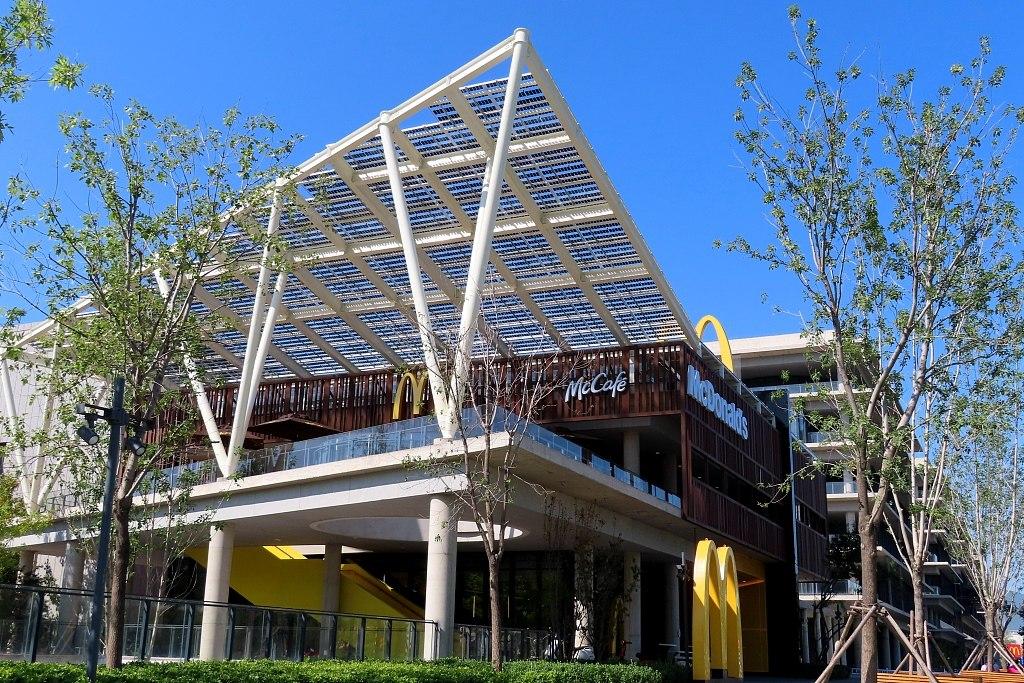
The appearance of Beijing McDonald’s Shougang Park drive-through restaurant, with photovoltaic power generation system laid on the roof. The picture is from McDonald’s.
At the same time,The complete set of energy-saving and consumption-reducing system of McDonald’s Green Restaurant saves 35% to 40% electricity in the whole building through energy-saving and consumption-reducing of IOT energy management system, variable frequency smoke exhaust system, air conditioning system, fresh air ventilation equipment and LED lighting system.The restaurant also uses the decoration materials certified by the international authoritative standard GREENGUARD for environmental protection, and strictly controls the chemical volatilization of the materials in the indoor air.
Green recycling is also a highlight of zero-carbon restaurants. As the core of green recycling, McDonald’s China "Remodeling Good Things" project redesigns and transforms the waste plastic products in restaurants, supply chains and industries into items needed by restaurants and consumers. For example, in the Shougang Park Restaurant of McDonald’s, the dining chairs used by customers are recycled from marine plastics, and the "Meng Meng Xiao Xiang" device displayed in the restaurant is also recycled from Happy Paradise dining toys.
Like other McDonald’s restaurants in China, McDonald’s Shougang Park Restaurant provides green packaging products such as 100% sustainable forest certification base paper (FSC) packaging bags, straw-free beverage cups and degradable plastic beverage bags.
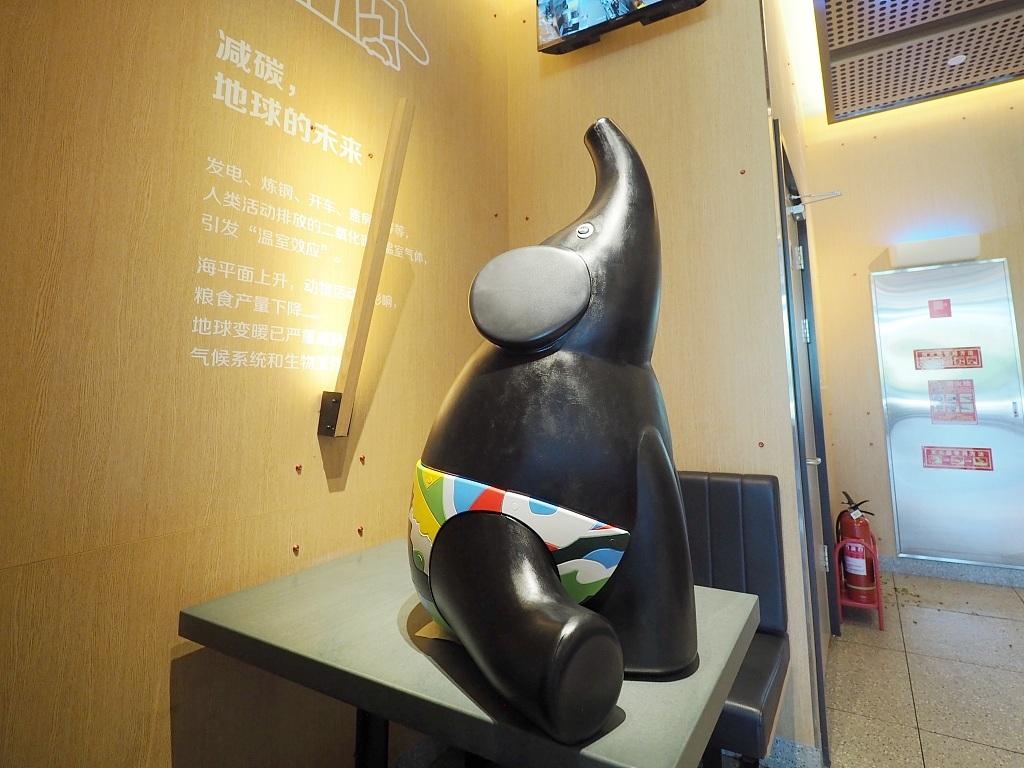
In the drive-through restaurant in Shougang Park of McDonald’s in Beijing, the "Meng Meng Elephant" recycled with Happy Paradise Dining Toys is particularly cute. The picture is from McDonald’s.
In recent ten years, McDonald’s China has been paying attention to the construction and operation of greener restaurants. Since 2013, McDonald’s China has been exploring green energy-saving ways of restaurants. In 2018, McDonald’s China introduced LEED certification, an international authority on green building, focusing on six core sectors, which provided a comprehensive framework of quantitative standards for the design, construction and operation of green restaurants.
It is understood that McDonald’s China has the largest number of LEED-certified green building projects in the world. By September 2022, nearly 1,600 McDonald’s restaurants had obtained LEED certification, reducing carbon emissions by about 60,000 tons per year.It is estimated that by the fourth quarter of 2022, McDonald’s China will complete the first phase of the construction of 1,800 LEED certified green restaurants ahead of schedule.
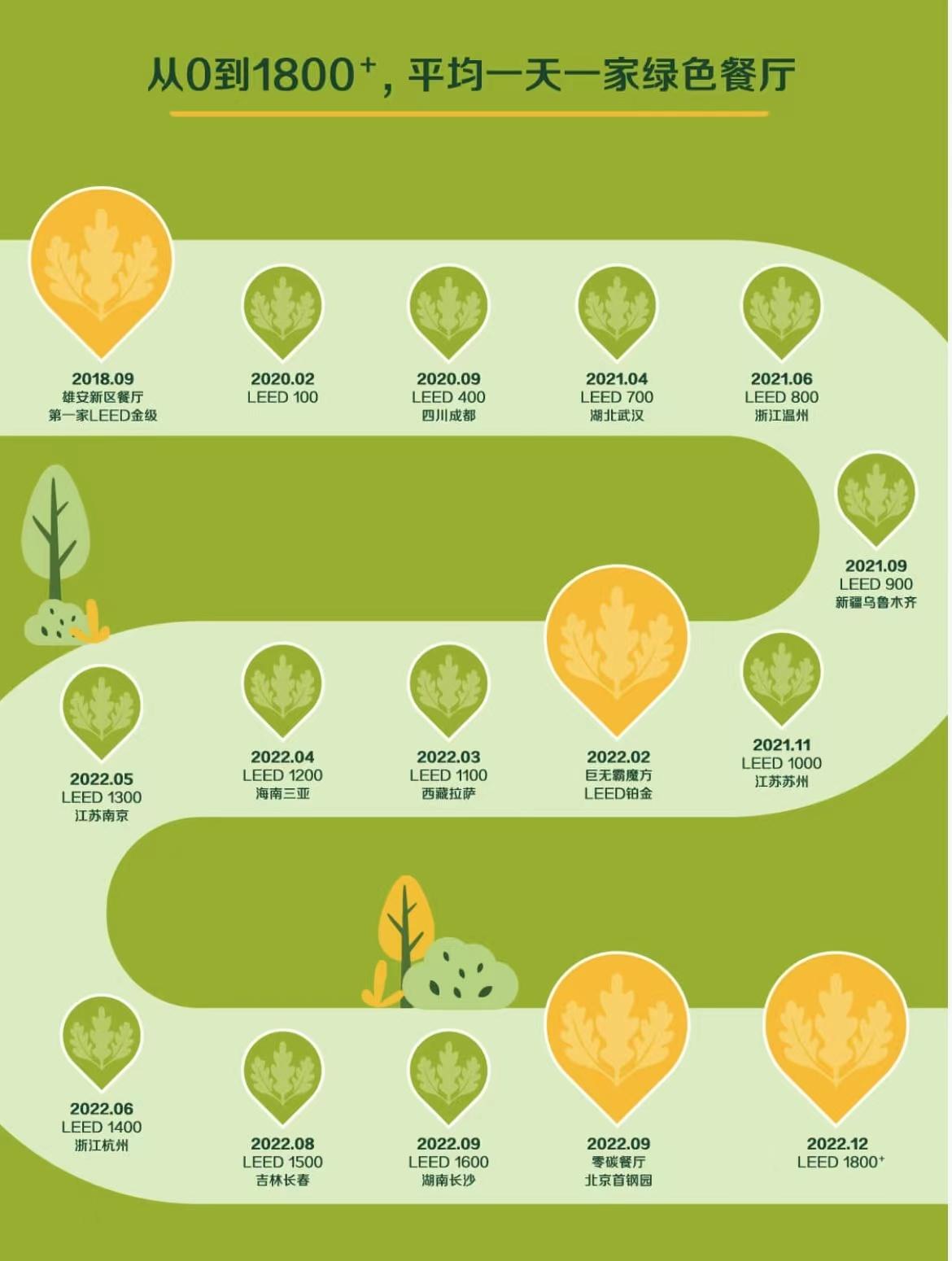
McDonald’s China "Green Restaurant" Development Milestone. The picture is from McDonald’s.
To celebrate the successful opening of McDonald’s zero-carbon restaurant, McDonald’s China recently launched the activity of "Green for the Future" in nearly 5,000 restaurants across the country. The paper bag seal changed from red to green, and consumers from all over the country were invited to experience the green and low-carbon lifestyle together. For example, Gaode Map and McDonald’s China jointly launched the Green Travel Medal Award, and consumers could go to McDonald’s restaurant to exchange gifts with the medal. At the same time, the coordinates of nearly 1,600 LEED-certified green restaurants will turn green on the McDonald’s China APP and applet, and you can also learn about McDonald’s green restaurants and LEED-certified environmental protection knowledge by clicking on the restaurant head.
In recent years, many catering brands are actively promoting low-carbon measures, which are not only reflected in encouraging consumers to adopt their own tableware, CD-ROM and other consumption behaviors, but also in practicing low-carbon concepts in the whole industry chain within enterprises, including reducing energy consumption and carbon emissions, adopting green packaging, green supply chain, etc., and using biotechnology, environmental protection technology and other means to achieve energy saving and carbon reduction from raw materials to consumption. Greening has become the development trend of the catering industry in the future.